

-
Main page

-
Mathematics
- Geometric Mean
Online Geometric Mean Calculator
Our Geometric Mean Calculator is a specialized tool designed to find the average of a set of numbers by using the product of their values. Unlike the standard arithmetic mean, the geometric average is ideal for data sets with wide ranges or when analyzing proportional growth, such as investment returns and population changes.
Geometric Mean Calculation Examples
How to find the geometric mean of 2, 8?
Result: 4
Step-by-step:
1. Multiply the numbers: 2 × 8 = 16.
2. Since there are 2 numbers, find the square root: √16 = 4.
Calculate the geometric mean of 4, 1, and 1/32
Result: 0.5
Logic: Multiply 4 × 1 × 0.03125 = 0.125. Since there are 3 values, take the cube root: ∛0.125 = 0.5.
Growth Rate Example (Returns of 10% and 50%)
Result: 1.284 (approx 28.4% average growth)
Calculation: For growth rates, use factors (1.10 and 1.50). √(1.10 × 1.50) = √1.65 ≈ 1.284.
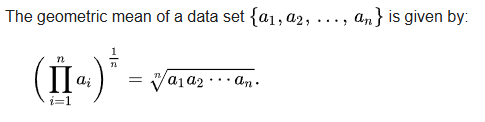
Formula Reference:
What is Geometric Mean? Rules & Application
The geometric mean is a type of average that indicates the central tendency of a set of numbers by using the root of their product. While the arithmetic mean adds numbers, the geometric mean multiplies them. This makes it significantly more accurate when dealing with percentages, ratios, and growth rates.
The Geometric Mean Formula
The calculation follows a specific mathematical rule: you multiply all $n$ values in the data set and then take the $n$-th root of the result. The formula is expressed as:
Geometric Mean = ⁿ√(x₁ × x₂ × … × xₙ)
When to Use Geometric Mean vs. Arithmetic Mean?
Choosing the right «average» is critical for data integrity:
- Arithmetic Mean: Use for independent values like test scores or heights.
- Geometric Mean: Use for dependent values, compounding growth, or when values have different scales. It is the standard for financial analysis and biology.
Practical Applications
Why do professionals use this calculator instead of a simple average? Here are the most common use cases:
- Investment Returns: Calculating the average annual growth rate (CAGR) of a portfolio over several years.
- Social Sciences: Used in the Human Development Index (HDI) to balance different social indicators.
- Biology: Analyzing bacterial growth or population dynamics where growth is exponential.
For more statistical tools, check our Mathematics section.
Important Limitations
Note that the geometric mean can only be calculated for positive numbers. If your data set contains a zero or a negative value, the result will be undefined or mathematically complex. For a deeper theoretical background, visit the detailed entry on Wikipedia.


