


VAT Calculator: Add or Remove VAT Online
Our free VAT calculator is designed to help businesses and shoppers quickly determine the Gross price (with tax) or Net price (without tax). Simply enter the amount and the tax rate to get an instant breakdown. Whether you need to calculate a price without VAT from a receipt or add tax to an invoice, our tool provides precise results instantly.
VAT Calculation
Practical Examples
Example 1: How to add 20% VAT to a $100 price?
Result: $120 (Gross Price)
Step-by-step:
1. Multiply the net amount by the tax rate: $100 × 0.20 = $20 (VAT amount).
2. Add the tax to the base price: $100 + $20 = $120.
Example 2: How to calculate price without VAT (from $120 total)?
Result: $100 (Net Price)
Step-by-step:
1. Divide the total (gross) amount by (1 + tax rate): $120 / 1.20 = $100.
2. The difference ($20) is the tax that was included in the price.
Example 3: Finding VAT for a 15% rate on a $50 net service
Result: $57.50
Calculation: $50 × 1.15 = $57.50.
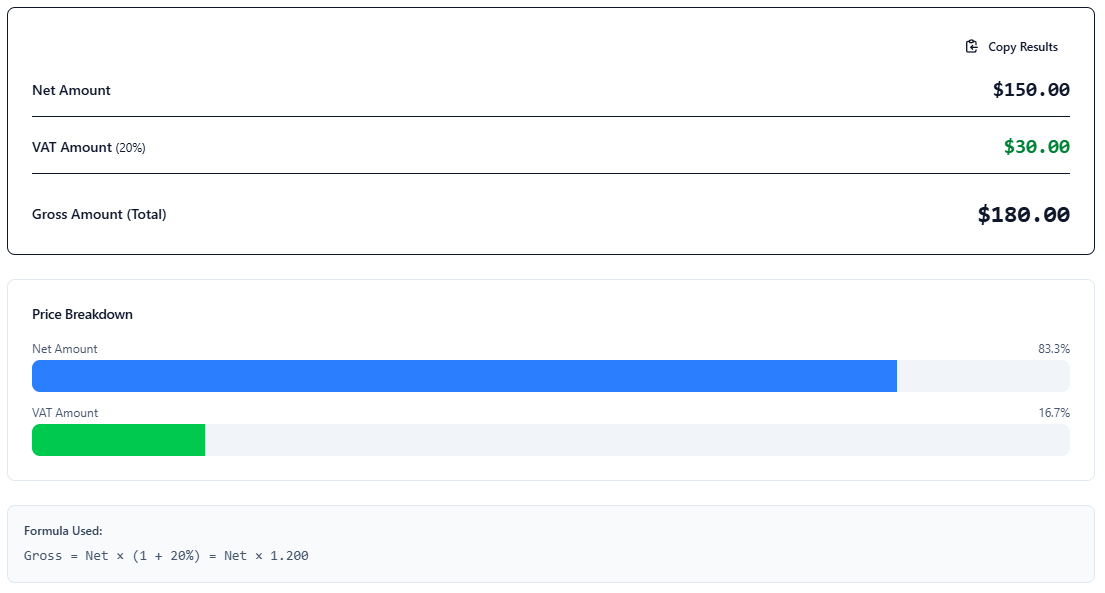
Visual Breakdown:
Understanding VAT: Inclusive vs. Exclusive
Value Added Tax (VAT) is a consumption tax added to a product’s price at each stage of production and distribution. For most people, the challenge lies in switching between VAT Inclusive and VAT Exclusive prices.
VAT Exclusive (Net Price)
This is the base cost of a product before tax is added. Businesses often quote prices «exclusive of VAT» because they can often reclaim the tax. If you see a net price, you must add the local tax rate to find out what you will actually pay.
VAT Inclusive (Gross Price)
This is the final «shelf price» you pay at a store. It already has the tax baked in. If you are an accountant or a business owner, you often need to remove VAT from this total to see the actual revenue (the Net price).
Common VAT Formulas
To ensure your accounting is accurate, you can use these standard formulas used by our solver:
- Add VAT: Gross = Net × (1 + VAT Rate)
- Remove VAT: Net = Gross / (1 + VAT Rate)
- VAT Amount: VAT = Gross — Net
Why Use an Online VAT Solver?
While the math seems simple, errors often occur when people try to «remove» tax by simply subtracting the percentage (e.g., subtracting 20% from a gross price is not the same as finding the original net price). Our VAT breakdown tool ensures you avoid these common accounting mistakes and get the exact figures for your invoices or tax returns.
What is Value Added Tax?
Value Added Tax (VAT) is a consumption tax placed on a product whenever value is added at each stage of the supply chain. From manufacturing to the final sale, it is a key source of revenue for many governments worldwide. For a deeper dive into the history and global implementation of this tax, you can read more on Wikipedia.


