

-
Main page

-
Mathematics
- Arithmetic Mean
Online Arithmetic Mean Calculator
Our Arithmetic Mean Calculator helps you compute the central value of any list of numbers in seconds. Whether you are a student working on statistics homework, a researcher analyzing data, or a business owner calculating average sales, this tool provides precise results with a step-by-step explanation of the formula.
Arithmetic Mean
Examples & Calculation
How to find the mean of 5, 10, and 15?
Result: 10
How to calculate:
1. Sum the numbers: 5 + 10 + 15 = 30.
2. Count the values: There are 3 numbers.
3. Divide the sum by the count: 30 / 3 = 10.
Calculate the average of a data set: 2, 4, 8, 10
Result: 6
Step-by-step:
The sum is 2 + 4 + 8 + 10 = 24. Since there are 4 values, the arithmetic mean is 24 / 4 = 6.
What is the mean of 1.5, 2.5, and 5?
Result: 3
Calculation: (1.5 + 2.5 + 5) / 3 = 9 / 3 = 3.
Image Example:
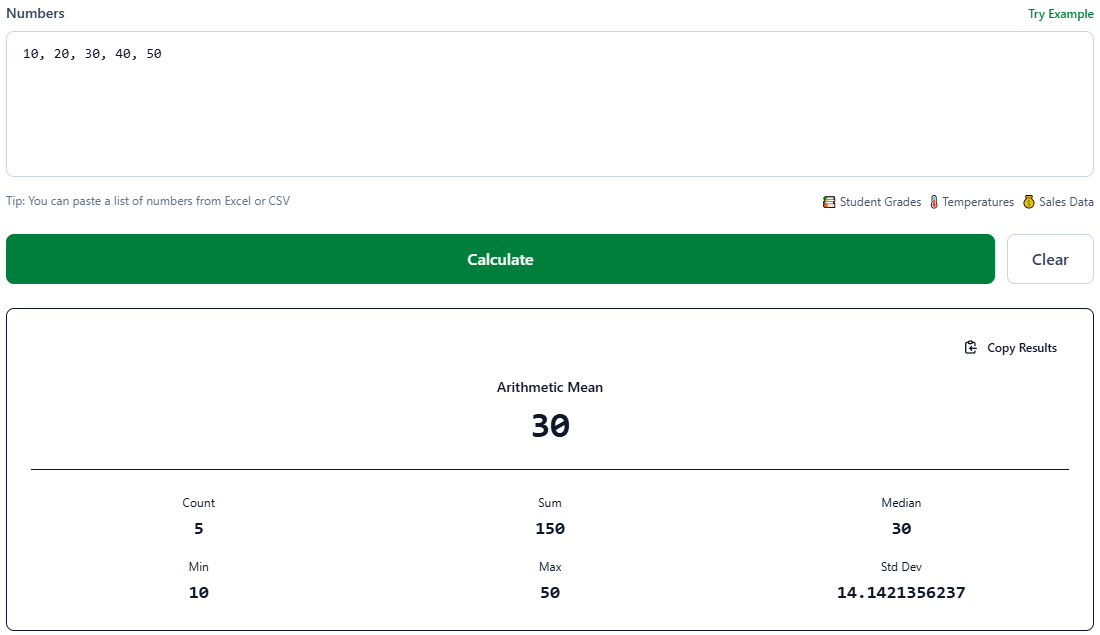
Understanding the Arithmetic Mean: A Comprehensive Guide
The arithmetic mean is perhaps the most fundamental concept in statistics. It provides a single value that represents the center of a data set. While most people simply call it «the average,» understanding how it works and when to apply it is crucial for accurate data interpretation.
How the Arithmetic Mean is Calculated
To find the mean, you follow two simple steps: sum and divide. First, you add up all the individual values in your data set. Second, you divide that total by the count of numbers in the list. Mathematically, it is expressed as:
Mean (x̄) = (x₁ + x₂ + … + xₙ) / n
Mean vs. Median vs. Mode: Which One Should You Use?
In the world of statistics, «average» is an umbrella term for three different measures of central tendency:
- Arithmetic Mean: Best for data that is distributed fairly evenly without extreme peaks.
- Median: The middle point of the data. It is highly effective when your data has outliers (for example, calculating average housing prices where one mansion could distort the mean).
- Mode: The most frequent value. This is useful when you want to know the most common result, such as the most popular shoe size in a store.
Practical Applications of Average Calculations
Why do you need an online mean solver? It’s not just for math class. Here is where the arithmetic mean plays a vital role:
- Academic Grading: Calculating your final grade based on multiple test scores.
- Business Analysis: Determining average daily foot traffic or monthly revenue trends.
- Lifestyle & Health: Tracking your average calorie intake, steps per day, or sleeping hours over a week.
- Finance: Investors use the mean to understand the average historical return of a stock or mutual fund.
The Impact of Outliers
One thing to keep in mind when using our calculator: the arithmetic mean is sensitive to extreme values. If you are averaging the numbers 1, 2, 3, and 100, the mean becomes 26.5. However, 26.5 doesn’t really represent the «typical» number in that set. This is why professional analysts often look at both the mean and the median to get a full picture of the data.


