

-
Main page

-
Mathematics
- Harmonic Mean
Online Harmonic Mean Calculator
Our Harmonic Mean Calculator is a precise tool designed to calculate the average of a set of numbers that represent rates or ratios. While the arithmetic mean is common for simple sets, the harmonic average is the mathematically correct choice for values like speed, frequency, or financial multiples, where outliers could otherwise distort the results.
Harmonic Mean
Examples & Calculation
How to find the harmonic mean of 2, 4, and 10?
Result: ~3.636
Step-by-step:
1. Find the reciprocals: 1/2, 1/4, 1/10 (0.5, 0.25, 0.1).
2. Sum the reciprocals: 0.5 + 0.25 + 0.1 = 0.85.
3. Divide the count (3) by the sum: 3 / 0.85 ≈ 3.636.
The Average Speed Puzzle
Question: You drive 60 km/h to a destination and return at 40 km/h. What is the average speed?
Result: 48 km/h (Note: The arithmetic mean would incorrectly say 50 km/h).
Calculation: 2 / (1/60 + 1/40) = 2 / (0.0166 + 0.025) = 2 / 0.04166 = 48.
Visual Reference:
Understanding the Harmonic Mean: When Ratios Matter
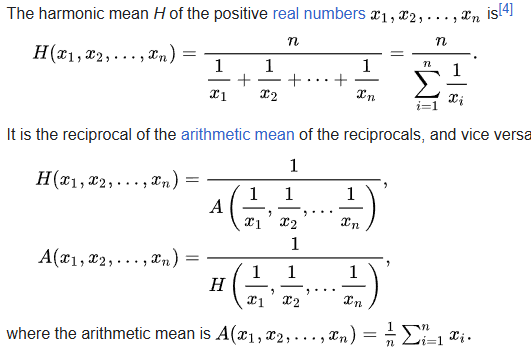
The harmonic mean is one of the three classical Pythagorean means. It is defined as the reciprocal of the arithmetic mean of the reciprocals of the data set. In simpler terms, it is a way to find a true average when dealing with quantities that change in relation to something else, like time or volume.
The Harmonic Mean Formula
To calculate it manually, you use the following mathematical rule:
H = n / (Σ (1/xᵢ))
Where n is the total number of values and Σ (1/xᵢ) is the sum of their reciprocals.
Key Use Cases
Why use this calculator instead of a standard average? Here is where the harmonic mean is indispensable:
- Average Speed: As shown in our example, it is the only correct way to average speeds over the same distance.
- Finance: Investors use it to average price-to-earnings (P/E) ratios. Using the arithmetic mean here often leads to an upward bias.
- Electronics: Calculating the equivalent resistance of resistors in parallel.
Explore more specialized tools in our Mathematics section.
Comparison: AM vs. GM vs. HM
It is important to remember the HM < GM < AM inequality. The harmonic mean will always be the smallest of the three averages (unless all numbers in the set are equal). This makes it very «resistant» to large outliers but sensitive to small values near zero. Learn more about the theory on Wikipedia.


